A nerve conduction study is one of the most precise diagnostic tools in neuromuscular medicine, but its value depends almost entirely on the specialist performing and interpreting it. At California Sports and Rehab, we see patients regularly who have had NCV studies at other facilities that produced inconclusive or incomplete results. A nerve conduction study specialist in Los Angeles brings more than equipment to the appointment. They bring the clinical training to design the right protocol, recognize unexpected findings, and interpret the data in the context of the patient’s full clinical picture. This blog explains what that looks like in practice.
What Is a Nerve Conduction Study and What Does It Measure?
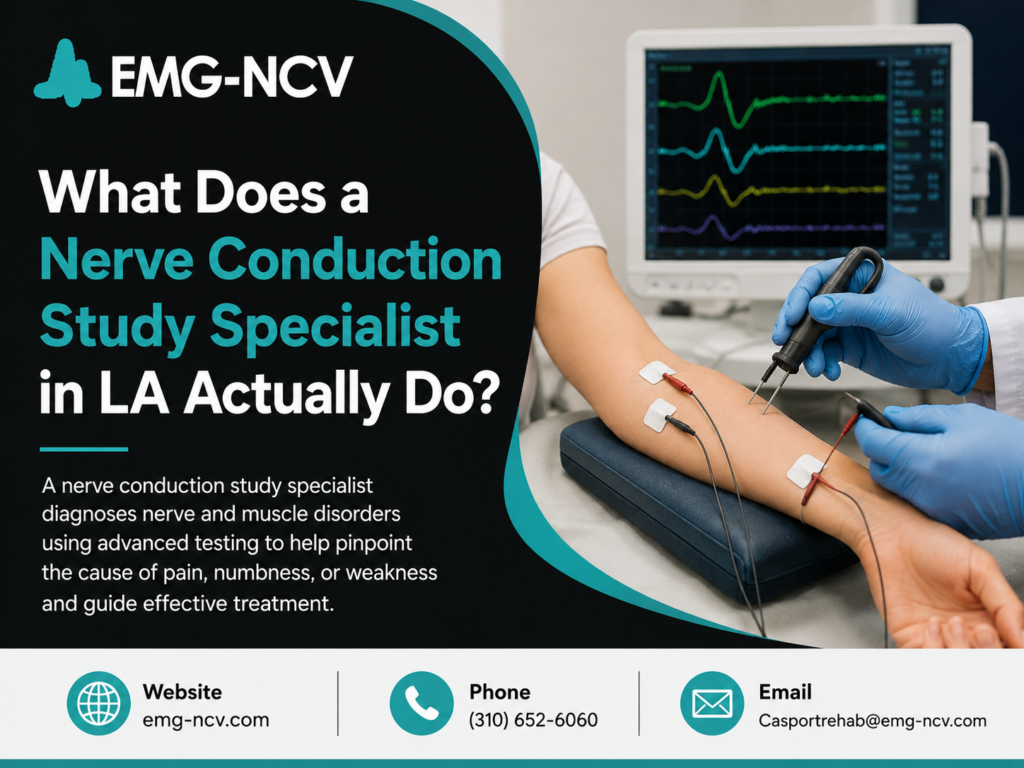
A nerve conduction study specialist in Los Angeles uses this test to measure the speed and strength of electrical signals traveling along specific peripheral nerves. Surface electrodes are placed on the skin overlying the nerve, a mild electrical stimulus is applied, and the equipment records the nerve’s response at a downstream recording site.
The two primary measurements are conduction velocity, expressed in meters per second, and amplitude, expressed in millivolts or microvolts. Conduction velocity reflects the integrity of the myelin sheath surrounding the nerve fiber. Amplitude reflects the number of functional nerve fibers contributing to the signal.
Nerve conduction results are interpreted against established reference values for the specific nerve being tested. Temperature, age, distance measurements, and testing technique can all affect the results, which is why proper technique and clinical interpretation are important. Focal slowing below these ranges at a specific anatomical site, such as across the wrist in carpal tunnel syndrome or across the elbow in cubital tunnel syndrome, localizes the compression. Diffuse slowing across multiple nerves suggests systemic disease rather than focal entrapment.
How Does a Specialist Design a Testing Protocol?
The nerve conduction test protocol is not standardized in the sense that every patient gets the same study. A nerve conduction study specialist designs the protocol around the clinical question. A patient presenting with hand numbness in the ring and small fingers needs ulnar nerve testing across the elbow and at the wrist, median nerve testing for comparison, and potentially radial sensory testing to rule out a more proximal lesion.
A patient with bilateral leg numbness and diabetic history needs a lower extremity sensory and motor protocol that evaluates multiple nerve segments to characterize the distribution and type of neuropathy. Adding or removing nerves from the protocol based on preliminary findings is a real-time clinical decision that only a physician present in the room can make.
This is the core difference between a specialist-led study and a technician-run study. The protocol flexibility, the real-time adjustment, and the immediate interpretation are physician functions, not equipment functions.
What Conditions Does the Nerve Conduction Test Diagnose?
The nerve conduction test is the primary diagnostic tool for a broad range of peripheral nerve disorders. The most commonly identified conditions at California Sports and Rehab include:
- Carpal tunnel syndrome: focal slowing of median nerve sensory conduction across the wrist
- Cubital tunnel syndrome: focal slowing of ulnar nerve conduction across the elbow, learn more at our cubital tunnel syndrome page
- Peripheral neuropathy: diffuse reduction in sensory or motor amplitude across multiple nerves
- Cervical radiculopathy: reduced amplitude in the motor nerves of the affected root distribution
- Peroneal neuropathy: focal slowing at the fibular head causing foot drop
- Tarsal tunnel syndrome: slowing of tibial nerve conduction across the ankle
Each of these has a specific electrodiagnostic signature that the specialist recognizes through the combination of velocity and amplitude findings across multiple nerve segments.
Why Physician-Led EMG/NCS Testing Matters
A nerve conduction study isn’t simply a matter of placing electrodes and recording numbers. The appropriate nerves and muscles need to be selected based on the patient’s symptoms, examination and suspected diagnosis. When findings are unexpected, the physician can modify the study while the patient is still being evaluated.
How Do the Results Guide Treatment Decisions?
The practical value of the nerve conduction study is in what it tells the treating physician about how to proceed. The findings fall into clinical categories that map directly onto treatment decisions.
Focal demyelinating compression with preserved amplitude means the nerve is compressed but the fibers are intact. Conservative treatment, splinting, activity modification, and possibly a steroid injection, is the first-line approach, and recovery potential is high.
Focal compression with reduced amplitude means axonal damage has occurred. The treatment urgency increases, and surgical consultation may be warranted earlier in the course. Recovery will be slower and potentially incomplete even with optimal management.
Diffuse neuropathy with length-dependent amplitude reduction means the problem is systemic, and identifying and treating the underlying cause is the priority. EMG findings in the muscles help clarify whether the neuropathy is predominantly motor, sensory, or mixed, which further guides the diagnostic workup.
What Should You Expect During and After the Study?
The nerve conduction study is performed in the clinic without sedation. Patients experience brief, mild electrical sensations during the NCV portion, described by most as a quick flick or tapping feeling. The sensations are not sustained and resolve immediately after each stimulus.
After the study, patients may notice mild skin redness at electrode sites, which resolves quickly. There are no restrictions on activity after an NCV-only study. If the EMG component is also performed, mild muscle soreness at needle insertion sites may persist for one to two days, which is normal and expected.
Booking Your Nerve Conduction Study at California Sports and Rehab
California Sports and Rehab has provided specialist-led nerve conduction studies for over 20 years to patients across greater Los Angeles. Dr. Tina Hakimian and Dr. Kamran Hakimian are directly involved in every study, from protocol design through interpretation and reporting. Visit EMG-ncv.com to learn more, read about the team, and book through the contact page or by calling 310-652-6060 at 12301 Wilshire Blvd Suite 207, Los Angeles, CA 90025.emg-ncv.comabout the teamcontact page
“`html
Frequently Asked Questions
A nerve conduction study measures electrical signal speed and strength along a nerve. An EMG measures electrical activity within a muscle. Both are usually performed together as a complete electrodiagnostic evaluation.
The electrical pulses used in the NCV produce brief, mild sensations that most patients describe as a quick tapping or flicking feeling. The majority of patients find the study more comfortable than they expected.
A standard NCV study takes approximately 30 to 45 minutes. Combined with EMG, the total appointment typically runs 45 to 60 minutes depending on the scope of testing.
A physician’s referral or order is typically required for insurance billing purposes. Contact the clinic to discuss your specific situation and insurance requirements.
NCV is most sensitive to large myelinated fiber damage, which covers the majority of common nerve entrapments and peripheral neuropathies. Small fiber neuropathy, which affects unmyelinated fibers, requires separate testing such as skin punch biopsy or quantitative sensory testing.
“`