
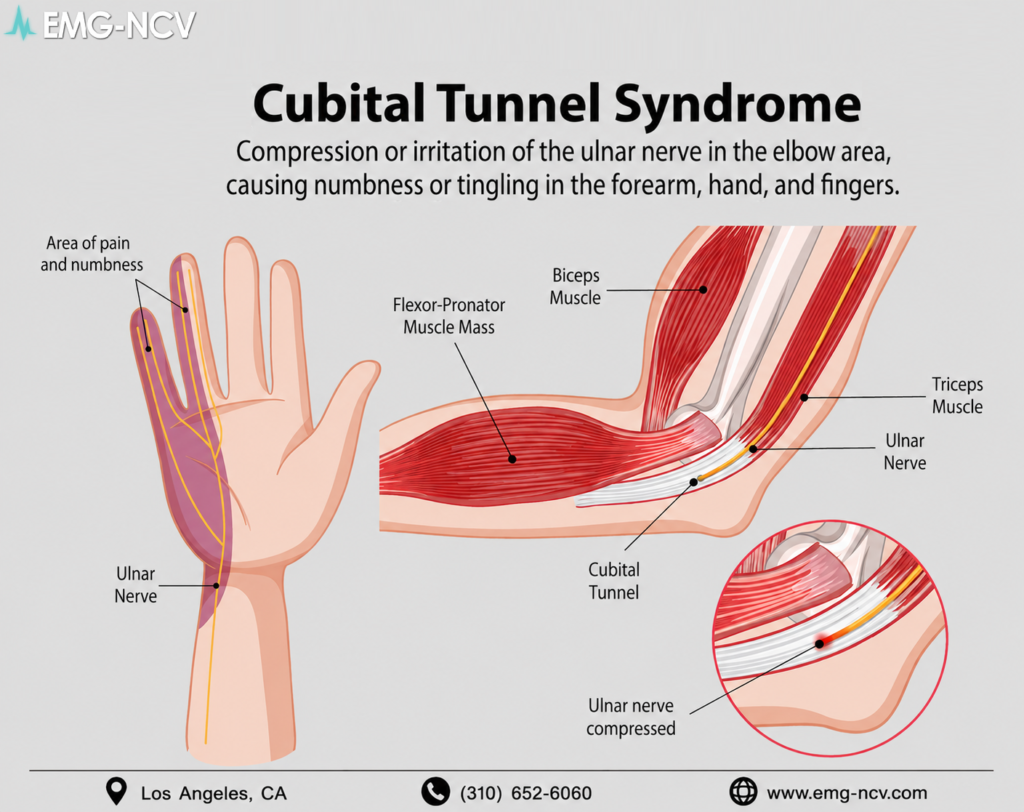
Cubital Tunnel Syndrome is the second most common peripheral nerve entrapment in the upper extremity, trailing only carpal tunnel syndrome. At California Sports and Rehab, we regularly see patients who have been managing elbow and hand symptoms for months before receiving an accurate diagnosis. The condition involves compression of the ulnar nerve at the elbow, and getting Cubital Tunnel Syndrome treatment right depends on catching it before the nerve sustains lasting damage. This blog walks through the anatomy, the diagnostic process, and the treatment options we use with our patients.
What Is Cubital Tunnel Syndrome and Why Does It Happen?
Cubital Tunnel Syndrome treatment begins with understanding what is causing the problem. The cubital tunnel is a narrow channel on the inside of the elbow through which the ulnar nerve passes. The nerve is relatively superficial at this point, making it vulnerable to pressure from sustained elbow flexion, direct trauma to the inner elbow, or anatomical changes like bone spurs or muscle hypertrophy around the joint.
The ulnar nerve controls sensation in the small finger and the ring finger, as well as motor function in most of the small muscles of the hand. When the nerve is compressed at the elbow, both sensory and motor function can be affected, and the pattern of deficit reflects the specific anatomy of ulnar nerve distribution.
Prolonged elbow flexion is the most common precipitating factor. Activities that require holding the elbow bent for extended periods, such as talking on the phone, resting the elbow on a desk, or sleeping with the arm curled under a pillow, can all elevate pressure within the cubital tunnel enough to compromise nerve function over time.
How Does It Feel Different from Carpal Tunnel Syndrome?
This question comes up often at California Sports and Rehab, and the distinction is important for accurate self-reporting before evaluation. Carpal tunnel syndrome affects the median nerve, producing numbness and tingling in the thumb, index finger, and long finger. Cubital tunnel syndrome affects the ulnar nerve, producing symptoms in the ring finger and small finger instead.
Patients with cubital tunnel syndrome also frequently report an aching or burning sensation along the inside of the elbow, and sometimes notice that their symptoms worsen when they bend the elbow or rest it on a hard surface. Weakness in grip and difficulty with fine motor tasks like pinching or buttoning clothing are more advanced signs suggesting the motor fibers of the ulnar nerve are being affected.
What Happens If Cubital Tunnel Syndrome Goes Untreated?
The ulnar nerve, like all peripheral nerves, has a limited window during which compression can be reversed without permanent consequences. Early compression produces intermittent symptoms that resolve when the nerve is decompressed, for example by straightening the elbow. Persistent or severe compression leads to axonal damage, which means the nerve fiber itself is injured rather than just the protective myelin sheath.
Axonal damage heals much more slowly than myelin injury and may not heal completely. Patients who reach this stage often develop permanent weakness in the hand intrinsic muscles, which manifests as difficulty spreading the fingers, loss of fine pinch strength, and in severe cases, visible muscle wasting between the thumb and index finger. This is why early evaluation matters.
How Does California Sports and Rehab Diagnose This Condition?
Our specialists Dr. Tina Hakimian and Dr. Kamran Hakimian use EMG and nerve conduction velocity testing to confirm the diagnosis and assess severity. The NCV component evaluates the speed and strength of the ulnar nerve signal as it crosses the elbow, comparing it to segments above and below. Focal slowing at the elbow localizes the compression to the cubital tunnel.
The EMG component evaluates the muscles innervated by the ulnar nerve, including the flexor carpi ulnaris, the intrinsic hand muscles, and the first dorsal interosseous. Denervation findings in these muscles indicate that the compression has produced axonal injury and that the treatment urgency and approach changes accordingly.
This level of diagnostic specificity is what makes our approach to cubital tunnel syndrome treatment effective. We do not rely solely on symptom history and clinical exam. The electrodiagnostic data tells us what grade of injury we are managing.
What Are the Treatment Options Available in West LA?
For cubital tunnel syndrome treatment in West LA and across the greater LA area, the path forward depends on severity. Mild cases with primarily demyelinating compression and no axonal loss are managed conservatively. This includes:
- Elbow splinting at night to prevent sustained flexion during sleep
- Activity modification to reduce prolonged elbow bending
- Padding to avoid direct pressure on the cubital tunnel
- Targeted physical therapy to reduce compensatory strain patterns
- Regular follow-up with electrodiagnostic reassessment to monitor nerve recovery
When conservative measures fail or the initial presentation shows significant axonal involvement, surgical decompression is considered. Options include simple decompression of the cubital tunnel roof, medial epicondylectomy, or ulnar nerve transposition, where the nerve is moved to a position anterior to the elbow to reduce tension during flexion. Surgical planning benefits from having a precise electrodiagnostic baseline established before the procedure.
Start Your Recovery at California Sports and Rehab
Ulnar nerve compression at the elbow does not improve on its own when it has reached the point of causing consistent symptoms and functional limitations. Early, accurate diagnosis through a proper electrodiagnostic study at California Sports and Rehab gives patients the clearest picture of what they are dealing with and what their realistic recovery options are.
Visit our about page to learn more about the specialists who lead this clinic, or call 310-652-6060 to book a diagnostic consultation at 12301 Wilshire Blvd Suite 207, Los Angeles, CA 90025.
Frequently Asked Questions
- Can cubital tunnel syndrome heal without surgery?
Many mild to moderate cases resolve with conservative management including splinting and activity modification, particularly when diagnosed before axonal damage has occurred.
- How long does cubital tunnel syndrome recovery take?
For conservative cases, improvement is often noticeable within weeks to a few months. Surgical recovery varies by procedure but generally involves a gradual return to full activity over two to three months.
- Is the EMG test painful for cubital tunnel syndrome evaluation?
Most patients find the test tolerable. The NCV portion produces brief mild electrical sensations, and the EMG needle portion causes minimal discomfort in most cases.
- Can I still use my hand during cubital tunnel syndrome treatment?
Yes, in most cases. Severe grip weakness or pain may limit certain activities, but complete rest of the hand is generally not advised and can cause secondary deconditioning.
- Does sleeping position affect cubital tunnel syndrome?
Yes, significantly. Sleeping with the elbow bent places sustained pressure on the cubital tunnel and is one of the primary causes of overnight symptom flares. A nighttime elbow extension splint often provides rapid relief.